

AI Applications·UpstreamRite

Every owner paid right, inside Oracle Fusion.

Most operators run owner revenue in a separate package and reconcile it to Oracle by hand each month. UpstreamRite prices each month’s oil, gas and NGL sales, takes out severance tax and lease deductions, splits the money by every owner’s exact decimal and pays them through Oracle Fusion.

Decks that total 1.00000000

One ledger for owner payments

Ten flows into Oracle Fusion

Two dates on every figure

Overview

Owner revenue that lives in Oracle Fusion.

Oracle Fusion has no module for upstream revenue accounting, so operators keep a second system for volumes, decks, royalties and owner payments, then tie it back to the ledger every month. UpstreamRite fills that gap. It gives revenue accounting teams one owner record, one payment run and one ledger, with cash and the general ledger staying in Fusion.

Keep owners, wells and vendors once, in one place, instead of in two systems.

Stop reconciling a revenue subledger to the general ledger by hand.

Pay owners through Oracle Payables rather than a separate check run.

See every held dollar with its reason and how long it has waited.


Send owners statements they can follow, well by well.
One owner record, one payment run. One ledger.

Features

From sold volumes to owner statements.

Five working parts take a month of production from the wellhead to a paid, posted and explained owner statement.

01

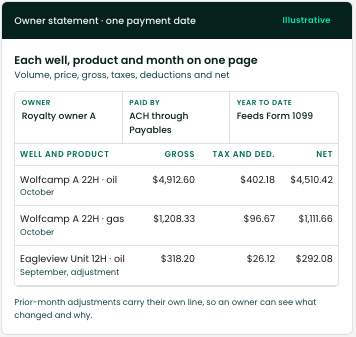
Owner statements and check stubs

By owner and payment date: each well's volume, price, gross, taxes, deductions and net, with print and PDF. One payment date can carry several production months and prior-period adjustments.

02

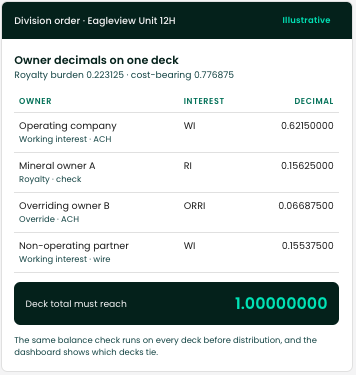
Division orders that balance

Royalty, overriding royalty and working interest owners in one list, on decks that must total exactly 1.00000000. Deck total, royalty burden and cost-bearing interest are shown for every well.

03

Revenue distribution

Decimal interests, severance tax, lease deductions, suspense and minimum pay, run and approved by well, owner or state. Amounts are never edited directly. Fix the setup and run it again.

04

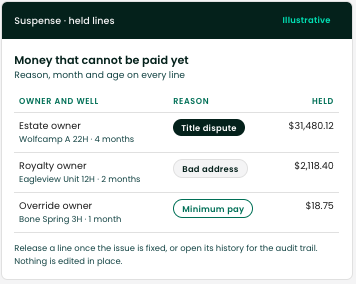
Suspense with a history

Every held line shows the owner, well, month, amount and reason. Release it once fixed, or open its audit trail.

05

Payments and accounting in Fusion

Owner payments through Payables, purchaser receipts and netting through Receivables, and revenue journals to the general ledger by well.

How it works

Five steps from the wellhead to the owner.

Each step has its own screen, controls and approval, and feeds the next. AI agents flag wells out of balance or owners held in suspense and explain why in plain English. An accountant approves every fix.

1

Bring in the volumes

Sold oil, gas and NGL come in from your production system, with checks before anything is valued.

2

Value the sales

Each well's sales are priced for the month and turned into gross value by product.

3

Split to every owner

Gross value is split by division order, then severance tax and lease deductions apply owner by owner.

4

Hold what cannot be paid

Title disputes, bad addresses and minimum pay go to suspense, with the reason and aging on every line.

5

Pay and post in Oracle Fusion

Owners are paid through Payables by check or ACH, and revenue journals post to the general ledger by well.

Security, governance and scale

Controls that must tie.

Volumes, prices, decks and distribution are checked against each other before the month closes. Every control passes before anyone is paid.

Runs with Oracle Fusion

The engine runs on Visual Builder, Oracle Integration Cloud and a database. Cash and the general ledger stay in Fusion.

People approve every fix

Agents built on Oracle Fusion AI Agent Studio explain and suggest. Nothing changes until an accountant approves it.

Never overwritten

A posted record is never changed. A correction creates a new version, and only the difference posts.

Two dates on every figure

When it was produced and when you learned it, so you can show what you knew and why it changed.

Configuration, not custom code

Rules are set up rather than coded, and every rule change is governed and tested before it runs.

Ready to experience UpstreamRite?

Download brochure